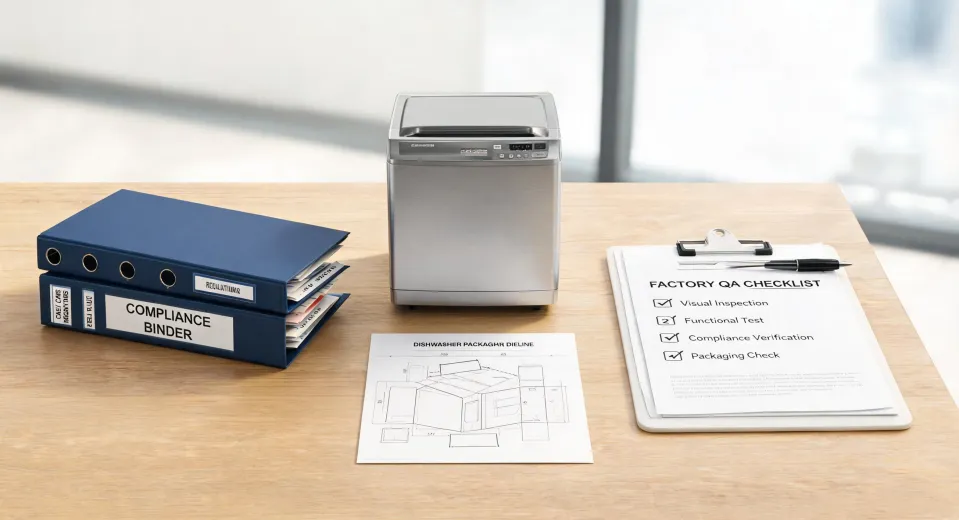
The repair invoice said $3,104. I remember it because I had to sign it twice—once to approve it, once after the accountant kicked it back asking why the dishwasher it was fixing had only cost $600 fourteen months earlier.
That's not a typo. We saved $600 on a 'budget-friendly' compact dishwasher for our kitchenette and spent more than five times that to keep it alive through its second year.
I manage procurement for a hospitality group—about 140 employees across three properties, including a commercial laundry and a breakfast service that runs seven days a week. My appliance budget is roughly $180,000 a year, and I've tracked every order, invoice, and service call in our cost system for six years. That dishwasher was one of the worst purchases I've made in all six.
I'm not naming the brand. That's not the point. The point is I bought it because my procurement process told me it was the smart choice. It wasn't. The process was wrong.
The Problem I Thought I Was Solving
For years, I compared appliances the way you compare office supplies: get three quotes, confirm the specs match, buy the cheapest that qualifies. I even had a written policy requiring quotes from at least three vendors. It looked disciplined. It looked like I was controlling costs.
It wasn't controlling costs. It was deferring them.
Every year the budget overran—not catastrophically, but steadily. A supplemental approval here, a rush order there, a $900 repair that 'couldn't wait until next quarter.' I told myself commercial gear just breaks. In 2023, we logged 41 service calls across three properties: washers, dryers, dishwashers, a refrigerator compressor, two heating elements, and a juicer that seized up in the middle of breakfast service.
The vendor failure in March 2023, when we lost the only working dishwasher in one building for a full week, changed how I think about appliance planning. One critical machine down, and suddenly every other team in the operation is scrambling around it.
What I Was Actually Getting Wrong
The surface problem was breakdowns. The deeper problem was that I was comparing the wrong number. I looked at purchase price, not total cost of ownership.
At the end of 2023, I finally sat down with six years of data and calculated what each appliance actually cost us per year of usable life: purchase, installation, energy, water, service calls, parts, and downtime. The results were humiliating.
The bargain dishwasher cost $3,704 over two years—$600 to buy, $3,104 to fix—which works out to about $1,850 per year of life. The Miele units we inherited at our largest property cost roughly $550 per year, including their higher purchase price and routine service, spread over six years. To be fair, the Miele machines were better engineered. But I couldn't have told you that from the initial quotes, because I'd never tracked lifecycle data in the first place.
People think expensive commercial equipment costs more because of branding. Actually, in my experience, it's the reverse: a manufacturer that can engineer a 20-year lifespan can charge a premium because the machine doesn't need constant attention. The price tag is the symptom, not the cause. The causation runs from engineering to price, not from price to quality.
That was the mindset shift. What was best practice in 2020—buy the lowest quote that meets the spec—doesn't hold up in 2025. The fundamentals haven't changed, but the execution has. We now have the data to prove that cheap appliances cost more. That changes every specification decision we make.
The Costs That Hide Below the Invoice
Once I started looking, the hidden costs were everywhere. Three stood out.
Duty cycle is a cost. A residential machine runs a few cycles a day. A commercial unit in a hotel can run several cycles an hour, all day long. That's not more of the same—it's a completely different engineering problem. When our F&B director asked which healthy juices to make with a juicer for the breakfast bar—carrot-apple-ginger, that sort of thing—the real question was whether the machine could handle sixty pounds of produce before 9 a.m. without seizing. It couldn't. We found that out the hard way.
Service network is a cost. A machine that works is an asset. A machine waiting for a technician is a liability. In Q2 2024, the Miele dryer at our San Francisco property threw a heating error on a Thursday. Our facilities manager searched for Miele dryer repair SF, found the authorized service center, and had a technician out the next day. The heating element was replaced within 48 hours. Total downtime: two days.
Contrast that with a different brand's unit at another property, where the service wait stretched to eleven days because the part wasn't stocked locally. The invoice for the outside laundry we used that week was higher than the repair itself.
Misunderstandings about maintenance are a cost. Our housekeeping team kept reporting a musty smell from the front-load washer. The first thing they found—like everyone does—was advice on how to add baking soda to a front load washer to fix it. We tried it, kind of. Half a cup in the drum on an empty hot cycle, every six weeks. It helped for about two weeks, then the smell came back.
The baking soda wasn't the fix. The actual problem was over-dosed detergent. We were using a commercial high-efficiency detergent but measuring it like the old top-loader stuff from a decade ago. The excess created biofilm in the drum seal, and no home remedy was going to fix a dosing error. We corrected the procedure, ran one deep-clean cycle with the manufacturer's recommended cleaner, and the smell hasn't returned in nine months. Our own maintenance routine was the machine's worst enemy—not the manufacturer.
The Real Cost of Getting It Wrong
Here's what six years of data says about the price of appliance mistakes.
Emergency repair premiums—expedited dispatch, after-hours rates, weekend calls—cost us $11,400 in 2023 alone. Every one of those was a breakdown we could have planned around if we'd been maintaining instead of reacting.
Downtime is more expensive than the repair, because it's invisible. Losing laundry capacity for a day at our largest property costs roughly $640 in outside services and lost productivity. An eleven-day wait isn't a service delay; it's a $7,000 operational hit.
And short-term choices compound. We saved $600 on that dishwasher and spent $3,104 fixing it. We bought a 'value' refrigerator that needed replacement after four years, while the Miele units installed in 2019 are still running on their original compressors (as of February 2025, at least). That's not magic. It's what happens when parts quality, engineering, and service support are designed for a longer life. You pay for that somewhere—upfront or repeatedly. I finally chose upfront.
What I Do Now
I didn't switch everything to Miele overnight. I'm a procurement manager; I don't make emotional decisions with corporate money. But I did change my specification framework, and Miele qualified every time I ran the calculation. (Which, honestly, is a sentence I never expected to write.)
Short version of the framework:
Compare total cost per year of life, not sticker price. Include energy, water, service contract, and expected lifespan. Our records support Miele's 20-year lifecycle claims for built-in appliances—I'd be more suspicious if I hadn't tracked the spreadsheets myself.
Verify the service network before you buy. When we started planning a kitchen renovation, I typed miele dishwasher dealers near me into a search engine as a test. Finding a seller was easy; finding a dealer with documented commercial installation experience took more work. That dealer flagged two installation details that would have voided our warranty—details our general contractor would have missed.
Match the equipment to the actual load. The juicer story taught us to ask about duty cycle first, menus second. The same principle applies to a hair dryer in a guest bathroom or a curling iron in the salon suite—each one has to survive hundreds of uses, not twenty.
Maintain by the manual, not by internet lore. The baking soda experiment wasn't harmful, but it wasn't the fix. What worked was reading the dosing table and using the products the manufacturer recommends. Your mileage may vary—but my spreadsheet says it won't.
I still get three quotes for every major purchase. I still negotiate. The budget is still $180,000 a year. The difference is that it now covers the cost of the equipment, instead of the cost of being cheap.
The most expensive appliance in our inventory was the one with the lowest sticker price. The cheapest was the one engineered to outlast the invoice.
Prices and service data referenced here come from our own procurement records (2019–2025); verify current rates with local providers. If you're about to spec a commercial kitchen or laundry room, run your own lifecycle projection before you sign anything. The math told me what I should have learned six years ago.