If you've ever searched “GE top load washer squeaks during agitation” at 6 a.m., you know that feeling. The machine is making a noise it shouldn't. You're not going back to sleep until you figure out whether it's a $20 fix or a $400 one.
I'm on the other side of that search. I'm a quality compliance manager at an appliance company, and I review units before they ever reach customers—roughly 50,000 items a year. When people search for “Dyson handheld vacuum battery life” or “Miele warranty vacuum,” they're not looking for specs. They're looking for help.
Here's what I've noticed after four years of doing this: those searches all point to the same problem. Not the individual defect. Something deeper.
The Symptoms Are All the Same
Let's break down what people are actually searching for.
The squeaking washer. That sound usually means the drive belt, tub bearing, or transmission is stressed. On a typical top-load washer, the repair bill—parts plus labor—runs 60-70% of what the machine cost new. So you're stuck with a choice most people don't want to make.
The dead vacuum battery. Lithium-ion cells lose runtime over time. That's chemistry. But whether you can do something about it is design. I don't have hard data on Dyson's specific battery failure rates, but from the units that come through our service center, the pattern is consistent: the pack is the first thing to go, and it's usually sealed shut. You're not replacing a battery. You're replacing an assembly.
The warranty question. Why do so many people search “Miele warranty vacuum” or “is this covered?” Because they've been burned before. They bought something, it broke, and the warranty turned out to be full of holes. That's not paranoia. That's experience.
Even the oddball query in the mix—“does using a massage gun help build muscle”—fits the pattern. No, it doesn't. It's a recovery tool. You can't massage your way to muscle. But people ask because the marketing said it would do one thing and the reality does another. Same story, different product.
These aren't random failures. They're the predictable output of how products are designed.
The Real Problem Is Boring
When I first started in quality, I assumed the most expensive components were always the right call. Three years of failure data changed my mind. The truth is more boring: most products fail because of quiet, deliberate choices made years before you unboxed them.
When a manufacturer designs to a price point, something has to give. Thinner steel. Cheaper bearings. Plastic where metal used to be. A battery pack that's glued together so you have to buy a new unit instead of a new cell.
That's not an accident. That's a business model.
Here's the counterintuitive part, the thing that took me the longest to accept: the most expensive appliance isn't the one with the highest sticker price. It's the one that fails just after the warranty expires. Or the one that requires a $400 repair on a $500 machine. Or the one that fails during your busiest week, when you run a hotel laundry and every hour of downtime means a guest with no clean towels.
What separates a product that lasts from a product that doesn't? In my view: testing. How many cycles did they run before shipping? What failure rate did they accept? I've seen the test reports for a $400 dishwasher and a $1,200 dishwasher. They're not in the same universe.
The expensive one was run for 10,000 cycles—Miele says that simulates about 20 years of household use. The cheap one? A few hundred cycles. The seals, the racks, the spray arms—all different materials, all validated differently. You're not paying for the logo. You're paying for what they did before the product ever reached you.
What Failure Actually Costs
Let's talk real numbers, not hypotheticals.
A few years back, we received a batch of goods where the finish was visibly off. Not functionally broken—just... wrong. The vendor said it was “within industry standard.” We rejected the batch. They redid it at their cost.
That quality issue cost us about $22,000 in delays and rework. It delayed our launch. But here's what I remember most: the customer didn't complain about the finish. They complained that we had to delay their order. The defect was invisible to them. The impact wasn't.
That's true for your appliances too. When your washer squeaks, the problem isn't the washer. It's the load of laundry that doesn't get done. The hotel room that can't be booked. The restaurant that runs out of clean towels mid-service.
If you're buying for a business, you're not buying an appliance. You're buying uptime. You're buying not having this conversation.
And if you're buying for your home, the math is simpler: a Miele dishwasher that runs for 15 years can be cheaper per load, per year, per headache, than one that fails in year four. That's why people hunt for “Miele dishwashers on sale.” The sale is nice. But the lifecycle cost is the real story.
What I Check Before I Approve Anything
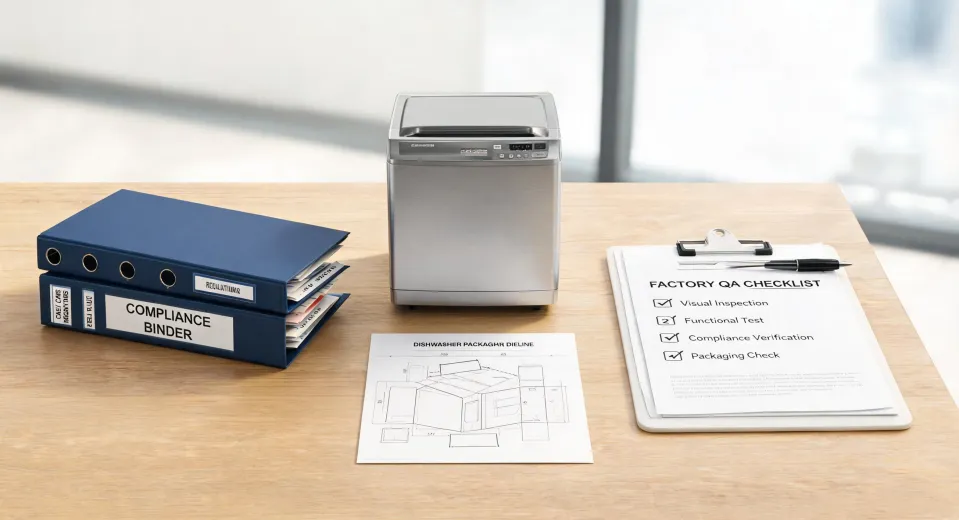
Here's the checklist I use when I'm reviewing a product. You can use it too.
1. Warranty language. Per the FTC's warranty regulations (16 CFR Part 700, under the Magnuson-Moss Warranty Act), a warranty must state, in plain language, what's covered, for how long, and what you need to do to claim it. If a warranty is vague on any of those, that's a red flag. When I review our own Miele warranty materials, I check for that clarity before anything goes out. Vague warranties aren't just unfriendly—they're a compliance issue.
2. Repairability. Can you actually replace the battery, the belt, the seal? Or is the whole thing designed to be discarded when one $8 part dies? In my experience, this single factor predicts long-term cost better than any other spec.
3. Test data. Ask what testing the product went through. If the answer is vague, the testing was probably minimal.
4. Service network. When something does fail, who responds? How fast do parts ship? A warranty that takes six weeks to honor isn't a warranty.
A $0.73 Detail
One small thing I always tell people: register your warranty. The stamp to mail the card costs $0.73 as of January 2025, per usps.com. Most people never do it. Then they're frustrated when a claim gets denied.
I register mine the day the product arrives. I photograph the serial number. I keep the receipt. Five minutes. And here's the thing—if a warranty is easy to register and easy to understand, that's a good sign. It means the company expects to honor it.
A Better Question
So, back to the massage gun. No, it won't help you build muscle. Neither will a cheaper appliance “save” you money if it constantly fails.
The right question isn't “what's on sale?” or “what looks good in the showroom?” The right question is: was this designed to last, and will someone stand behind it if it doesn't?
That's what I look for. Not perfection—I've rejected good products for small issues, and I've signed off on products that still failed in the field. But the pattern is clear: products that are tested honestly, warranted clearly, and built to be repaired fail less. And when they do fail, someone answers the phone.
Everything else is just noise.