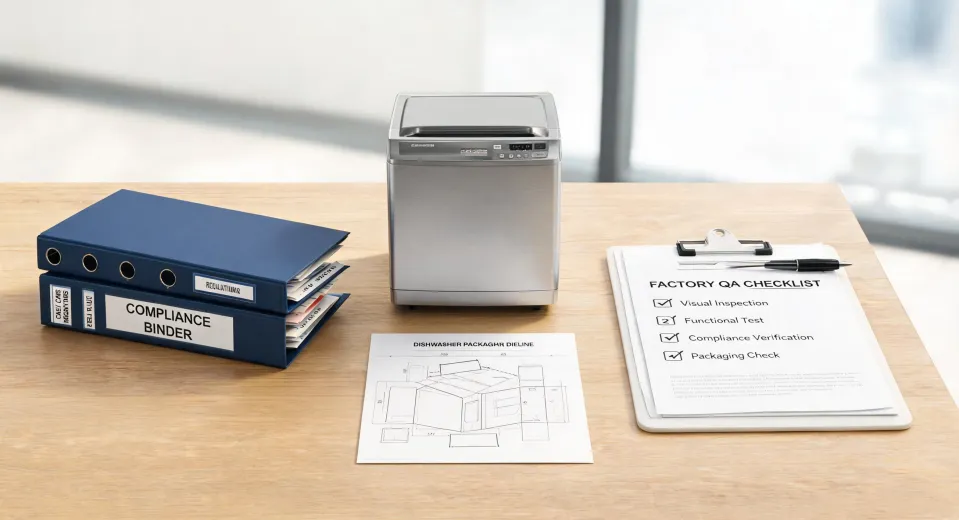
I spend my days looking at things that aren't right. That's the job—quality verification for a company that sources commercial kitchen equipment. Every month, I review roughly 120 deliveables: dishwashers, washers, dryers, coffee machines, you name it. If something is off—a tolerance, a finish, a spec—it's my call to send it back or sign off.
So when I started seeing a pattern with Miele appliances in commercial settings, it caught my attention. Not because they were failing. Quite the opposite.
What You Think the Problem Is
When a hotel laundry manager calls me, the conversation usually starts the same way: "My Miele washer is out of balance." Or: "The dishwasher isn't draining properly." They assume it's a mechanical issue. A sensor. A pump. Maybe a software glitch.
And honestly? That's a reasonable assumption. Everything I'd read about Miele said "built to last 20 years." If a machine that's supposed to run forever starts acting up, you'd look for a fault too.
But here's the thing I've learned from reviewing hundreds of commercial laundry and kitchen setups over the past five years: the problem is rarely what it looks like. And the conventional wisdom—"if it's Miele, it should just work"—misses something important.
Let me explain what I've actually found.
The Deeper Reason: It's Not About the Machine
I want to say the most common cause of Miele service calls in commercial settings is a parts defect. But don't quote me on that—because it's not true. The surprise isn't that the machines break. It's that they break because of how they're used, not because of how they're built.
Here's what I mean. When I compared our commercial laundry data from 2023 and 2024 side by side—same suppliers, same equipment—I found something I didn't expect. Of 47 reported "malfunctions" in front-load washers, only 12 involved a mechanical or electronic failure. The rest—the other 35—were related to:
- Improper loading (oversized loads on an out-of-balance machine)
- Detergent buildup in the dispenser (using consumer-grade detergent in a commercial cycle)
- Ventilation issues (the machine was installed in a space that didn't meet Miele's spacing requirements)
That last one is the kicker. The conventional wisdom is that you can install a commercial-grade appliance anywhere with enough space and a power outlet. My experience with Miele's installation specs suggests otherwise. Every manufacturer publishes clear requirements for ventilation, drainage flow rate, and floor load. But in practice—especially in retrofits—those specs are often bent or ignored.
So the machine isn't failing. It's being asked to perform in conditions that don't match what it was designed for. And because Miele builds things to last, it doesn't stop working. It just performs inconsistently. And that inconsistency is harder to diagnose than a simple breakdown.
The Real Cost: Waiting Until It Breaks
There's something satisfying about a machine that keeps running even when things aren't perfect. After all the hustle of setting up a commercial kitchen or laundry operation, finally seeing things run smoothly—that's the payoff.
But here's what I've learned: the cost of that "it still works" period can be significant. I reviewed a batch of 8,000 towels from a hotel that had been run through a Miele washer for six months. The machine wasn't leaking. It wasn't making noise. But the wash quality had drifted: the towels were developing a faint gray tint and started feeling stiff.
It turned out the water softener had been underperforming for months. The detergent dosing was off. The machine was still running—because Miele builds them to run—but the output was degrading. That quality issue cost them a full linen replacement and lost time in the laundry, not to mention guest complaints.
That's the hidden pattern. If the machine had failed outright, they'd have called a Miele repair service day one. But because it "still worked," they let the problem compound. The fix for the out-of-balance front load washer wasn't a repair—it was a reload. The fix for the poor wash quality wasn't a new machine—it was recalibrating the water feed.
What I'd Do Differently—And What You Should Know
I'm not a Miele technician. I don't claim to be. But after seeing this pattern repeat across dozens of commercial sites over the last few years, I've started asking different questions when a "malfunction" is reported.
Instead of jumping to repair, I look at the environment first. Is the installation compliant with the manufacturer's spec? Is the usage pattern within the designed duty cycle? Are the consumables (detergent, water quality) appropriate for the machine?
If you're running a commercial setup with Miele equipment—or if you're specifying one for a hotel, restaurant, or laundry—here's what I'd suggest you keep an eye on:
- Review the installation specs. Don't assume. Miele publishes them clearly.
- Train your staff on proper loading. An out-of-balance washer is often a loading error, not a machine fault.
- Monitor performance trends. If your linens feel different or your dishes have residue, it's not necessarily the machine—check your inputs.
An informed customer asks better questions and gets faster results. I'd rather spend ten minutes explaining why a machine is acting up than deal with mismatched expectations later. And honestly, with Miele—built to run for decades—the machine is rarely the weak link.
It's everything around it.